

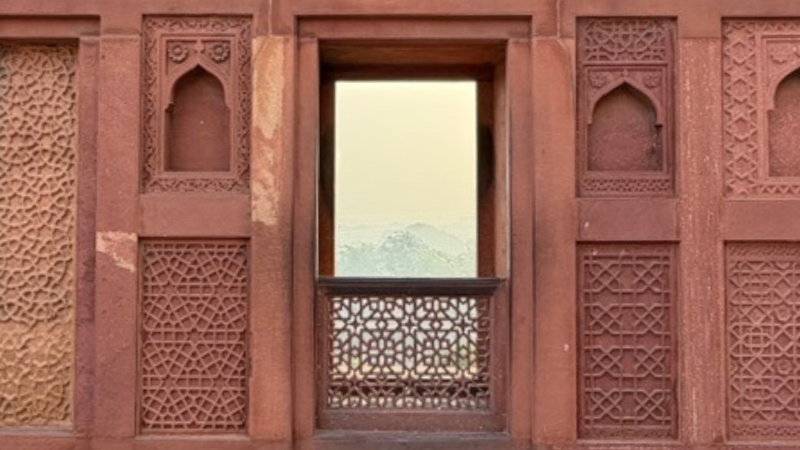
The Geometry of Empire: Exploring the Mughal Design Language in Agra Fort
One of the grandest and most historically layered of Mughal structures, built primarily by Emperor Akbar, the fort marked the return of the Mughal capital from Fatehpur Sikri to Agra which was then a flourishing trade hub strategically located along the Yamuna River. The abundant water supply and proximity to trade routes made Agra a center of power, beauty, and innovation.
The Agra Fort evolved under the reigns of Akbar, Jahangir, and Shah Jahan, reflecting three generations of architectural refinement. Its patterns appear in sandstone carvings, ceramic tile inlays, marble petra dura and delicate jalis, each reflecting a different moment in the empire’s story - from Akbar’s robust grandeur to Shah Jahan’s poetic delicacy.
In this course, students will wander through the fort’s architecture, observing and analysing a range of geometric systems of 4-, 5-, 6-, 10-, and 12-fold symmetries. By now, students will have developed a strong vocabulary of geometric construction and will use this knowledge to identify base grids, repeat motifs, and symmetry groups within the patterns.
We will also study the translation of geometry across materials as found around the fort from carved stone to painted surface. We will observe how scale, depth, and light change the nature of ornament. The course will conclude with exercises on border designs and pattern combinations, showcasing the rich visual rhythm of the Agra Fort.
Images courtesy of Jyotika Purwar
Booking Options
One of the grandest and most historically layered of Mughal structures, built primarily by Emperor Akbar, the fort marked the return of the Mughal capital from Fatehpur Sikri to Agra which was then a flourishing trade hub strategically located along the Yamuna River. The abundant water supply and proximity to trade routes made Agra a center of power, beauty, and innovation.
The Agra Fort evolved under the reigns of Akbar, Jahangir, and Shah Jahan, reflecting three generations of architectural refinement. Its patterns appear in sandstone carvings, ceramic tile inlays, marble petra dura and delicate jalis, each reflecting a different moment in the empire’s story - from Akbar’s robust grandeur to Shah Jahan’s poetic delicacy.
In this course, students will wander through the fort’s architecture, observing and analysing a range of geometric systems of 4-, 5-, 6-, 10-, and 12-fold symmetries. By now, students will have developed a strong vocabulary of geometric construction and will use this knowledge to identify base grids, repeat motifs, and symmetry groups within the patterns.
We will also study the translation of geometry across materials as found around the fort from carved stone to painted surface. We will observe how scale, depth, and light change the nature of ornament. The course will conclude with exercises on border designs and pattern combinations, showcasing the rich visual rhythm of the Agra Fort.
Images courtesy of Jyotika Purwar
Our payments are processed using : Sage Pay