
Stained Glass: Contemplating the Tree of Life
Since the beginning of our shared human existence we have created myths and stories to understand our world. The tree universally symbolises the vertical axis which connects the underworld, the earthly world of man and the heavenly realms above. The Tree of Life is a fundamental universal archetype which takes form in different mediums in art across the world.
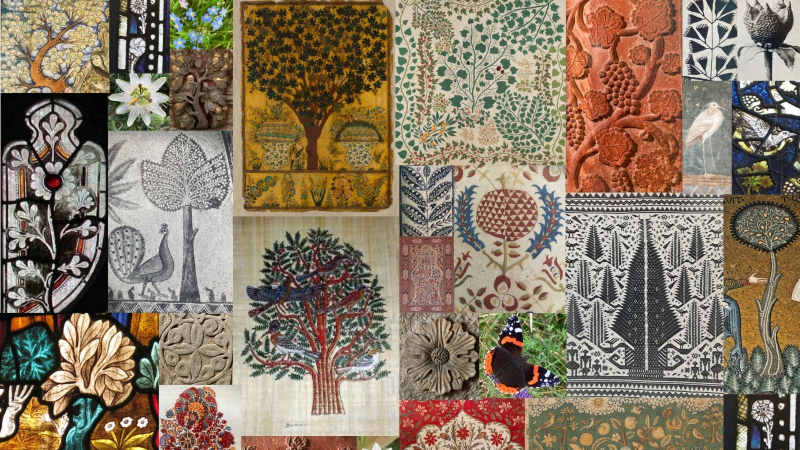
During this week‑long course, participants will explore the symbolism of the Tree of Life across different cultures. Each person will then create their own interpretation of this symbol—either from imagination or inspired by a collection of images. These may include birds, insects, animals, leaves, flowers, or various plant and tree forms. References can come from photographs, sketches, or ancient artworks. The Tree of Life design may be simple or visually intricate, depending on what each participant prefers. Museums, books, and Islamic rugs are all excellent sources of inspiration. The tutor will also provide a few ready‑made designs for anyone who prefers not to create their own from scratch.
When developing their designs, participants should keep in mind the practical requirements of painted stained glass. The technique has particular constraints that need to be considered so that the artwork translates effectively into the medium. The final glass panel will be approximately 30 × 30 cm, though it may be square or rectangular depending on what best suits the composition.
The week begins with an illustrated introduction to the symbolism of the Tree of Life, followed by time for participants to develop their own designs and map out the necessary glass‑cutting lines. Once designs are finalised, the next stage is cutting the glass pieces that will form each panel. This is followed by the first round of painting, starting with the trace line and some initial tonal work, after which the pieces are fired in the kiln. The following session continues with additional layers of painting, and, if time allows, the application of silver stain to achieve a transparent golden yellow on white glass. The week concludes with leading the panels, soldering, cementing, and attaching hanging hooks to complete the finished artwork.
Booking Options
Since the beginning of our shared human existence we have created myths and stories to understand our world. The tree universally symbolises the vertical axis which connects the underworld, the earthly world of man and the heavenly realms above. The Tree of Life is a fundamental universal archetype which takes form in different mediums in art across the world.
During this week‑long course, participants will explore the symbolism of the Tree of Life across different cultures. Each person will then create their own interpretation of this symbol—either from imagination or inspired by a collection of images. These may include birds, insects, animals, leaves, flowers, or various plant and tree forms. References can come from photographs, sketches, or ancient artworks. The Tree of Life design may be simple or visually intricate, depending on what each participant prefers. Museums, books, and Islamic rugs are all excellent sources of inspiration. The tutor will also provide a few ready‑made designs for anyone who prefers not to create their own from scratch.
When developing their designs, participants should keep in mind the practical requirements of painted stained glass. The technique has particular constraints that need to be considered so that the artwork translates effectively into the medium. The final glass panel will be approximately 30 × 30 cm, though it may be square or rectangular depending on what best suits the composition.
The week begins with an illustrated introduction to the symbolism of the Tree of Life, followed by time for participants to develop their own designs and map out the necessary glass‑cutting lines. Once designs are finalised, the next stage is cutting the glass pieces that will form each panel. This is followed by the first round of painting, starting with the trace line and some initial tonal work, after which the pieces are fired in the kiln. The following session continues with additional layers of painting, and, if time allows, the application of silver stain to achieve a transparent golden yellow on white glass. The week concludes with leading the panels, soldering, cementing, and attaching hanging hooks to complete the finished artwork.
Our payments are processed using : Sage Pay