Boddhisatva of Infinite Compassion
Bodhisattva Avalokiteshvara—revered across Buddhist traditions for his boundless compassion—is known by many names: Karunamaya and Lokeshvara in Nepal, Chenrezig in Tibet, Kannon in Japan, and Guanyin in China. It is said that Avalokiteshvara vowed not to attain enlightenment until all sentient beings are liberated from the cycle of suffering. This spirit of selfless service through compassion (karuṇā) lies at the heart of his practice and veneration in Mahayana and Vajrayana Buddhism.
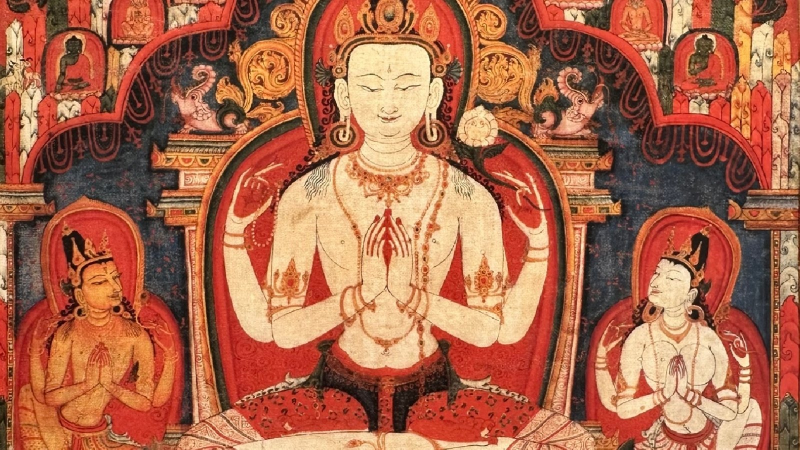
Commonly depicted in a serene four-armed form, Avalokiteshvara appears in radiant white, seated peacefully on a moon disk atop a fully blossomed lotus—embodying purity, empathy, and peaceful presence.
For centuries, Buddhist practitioners have regarded the act of painting Buddhas and bodhisattvas as a path of inner cultivation and realization. In this week‑long immersive course, students will explore Avalokiteshvara not only as an artistic subject but also as a profound symbol of compassion.
Guided step‑by‑step, participants will create their own painting of Avalokiteshvara using the traditional techniques of Paubhā painting, the sacred art form of Nepal. Through contemplative practice and hands‑on instruction, students will gain an integrated understanding of:
- the history and philosophy behind Avalokiteshvara,
- the iconography and symbolism of his various forms,
- and the materials, methods, and aesthetics central to the Paubhā tradition.
Students may choose to trace from provided templates or draw freehand according to their comfort level.
Booking Options
Bodhisattva Avalokiteshvara—revered across Buddhist traditions for his boundless compassion—is known by many names: Karunamaya and Lokeshvara in Nepal, Chenrezig in Tibet, Kannon in Japan, and Guanyin in China. It is said that Avalokiteshvara vowed not to attain enlightenment until all sentient beings are liberated from the cycle of suffering. This spirit of selfless service through compassion (karuṇā) lies at the heart of his practice and veneration in Mahayana and Vajrayana Buddhism.
Commonly depicted in a serene four-armed form, Avalokiteshvara appears in radiant white, seated peacefully on a moon disk atop a fully blossomed lotus—embodying purity, empathy, and peaceful presence.
For centuries, Buddhist practitioners have regarded the act of painting Buddhas and bodhisattvas as a path of inner cultivation and realization. In this week‑long immersive course, students will explore Avalokiteshvara not only as an artistic subject but also as a profound symbol of compassion.
Guided step‑by‑step, participants will create their own painting of Avalokiteshvara using the traditional techniques of Paubhā painting, the sacred art form of Nepal. Through contemplative practice and hands‑on instruction, students will gain an integrated understanding of:
- the history and philosophy behind Avalokiteshvara,
- the iconography and symbolism of his various forms,
- and the materials, methods, and aesthetics central to the Paubhā tradition.
Students may choose to trace from provided templates or draw freehand according to their comfort level.
Our payments are processed using : Sage Pay