

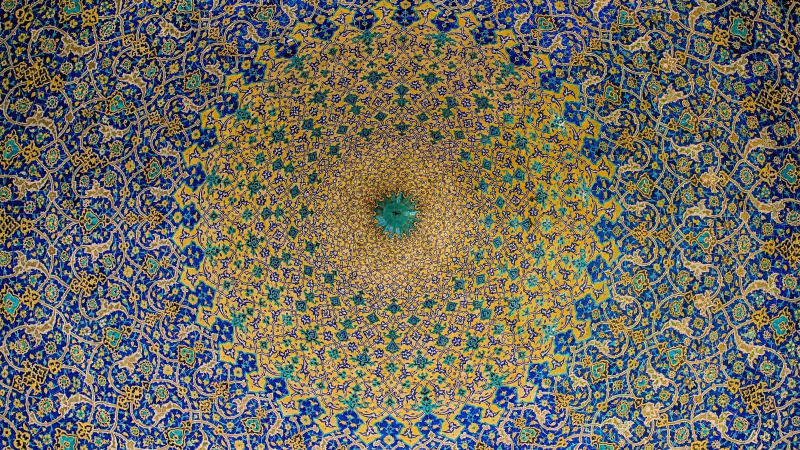
Decoding Ornament in Islamic Art
Learn to see, analyse and creatively engage with Islamic influenced ornamentation across manuscripts, architecture and decorative arts. Through guided observation and practical exercises, this visually rich course explores underlying design principles, cultural context and artistic language that shapes these timeless traditions.
Session 1: Seeing Pattern and Rhythm
In this session, students will study a single illuminated Qur’an folio or border to observe pattern and rhythm. They will break down a repeating section of the design and recreate a sketch of that repeat. For homework, students will complete the repeat fully and extend it to form a complete corner design.
Session 2: Hidden Geometry and Structure
Students will explore an architectural element, such as a radial dome design or wall pattern, to understand the hidden geometry within decorative arts. They will learn about symmetry, underlying grids, and repeating elements, and will be guided through the process of breaking down and constructing the design. For homework, students will complete the full design and paint it.
Session 3: Language of Motifs
This session introduces various motif types, including Rumi, Hatayi, and Bulut forms. Students will explore their cultural context and learn how to draw a single floral motif. For homework, they will study a real flower and create a stylised, coloured version inspired by traditional design principles.
Session 4: Colour Theory and Painting
Students will examine different manuscripts to understand colour application, including the importance of gold and the use of colour across various traditions. The session will focus on how colour enhances meaning and aesthetic value. For homework, students will reinterpret a design using a limited colour palette.
Session 5: Composition, Complexity, and Layering
In the final session, students will explore compositional balance, the importance of visual breathing space, and the layering of complex designs. They will analyse how intricate compositions are structured and interact visually. As a task, students will deconstruct a design to identify and show its different layers.
Booking Options
Learn to see, analyse and creatively engage with Islamic influenced ornamentation across manuscripts, architecture and decorative arts. Through guided observation and practical exercises, this visually rich course explores underlying design principles, cultural context and artistic language that shapes these timeless traditions.
Session 1: Seeing Pattern and Rhythm
In this session, students will study a single illuminated Qur’an folio or border to observe pattern and rhythm. They will break down a repeating section of the design and recreate a sketch of that repeat. For homework, students will complete the repeat fully and extend it to form a complete corner design.
Session 2: Hidden Geometry and Structure
Students will explore an architectural element, such as a radial dome design or wall pattern, to understand the hidden geometry within decorative arts. They will learn about symmetry, underlying grids, and repeating elements, and will be guided through the process of breaking down and constructing the design. For homework, students will complete the full design and paint it.
Session 3: Language of Motifs
This session introduces various motif types, including Rumi, Hatayi, and Bulut forms. Students will explore their cultural context and learn how to draw a single floral motif. For homework, they will study a real flower and create a stylised, coloured version inspired by traditional design principles.
Session 4: Colour Theory and Painting
Students will examine different manuscripts to understand colour application, including the importance of gold and the use of colour across various traditions. The session will focus on how colour enhances meaning and aesthetic value. For homework, students will reinterpret a design using a limited colour palette.
Session 5: Composition, Complexity, and Layering
In the final session, students will explore compositional balance, the importance of visual breathing space, and the layering of complex designs. They will analyse how intricate compositions are structured and interact visually. As a task, students will deconstruct a design to identify and show its different layers.
Our payments are processed using : Sage Pay