

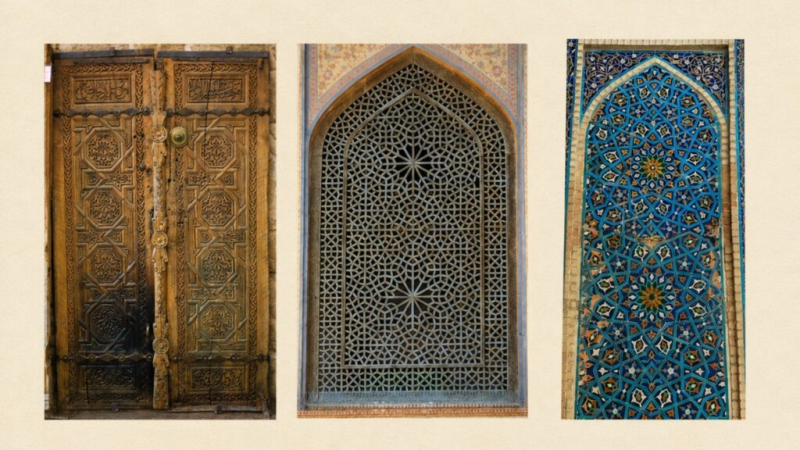
Understanding Pattern Families: A Logical Approach to Geometric Pattern Construction
Grounded in analytical methodologies, this four-day workshop offers an in-depth exploration of alternative ways of perceiving and understanding geometric patterns. Combining traditional ruler-and-compass constructions with contemporary analytical approaches, participants will learn to uncover hidden structural relationships across a wide range of geometric forms.
Each day begins with a single geometric pattern and gradually unfolds into a journey of discovery, revealing connections to seemingly unrelated patterns. Through observation, construction, analysis, and discussion, participants will develop new ways of seeing geometry as an interconnected system of forms and transformations.
The Six-Fold Lattice Pattern Family
These designs, more commonly encountered in Ottoman “ahcar-ı müshabbaka” (stone latticework) applications, are known today in Iran and Azerbaijan as droudgari (carpentry lattice patterns). Visually distinct from many other pattern families, these designs are fundamentally characterised by deltoids, which also form the key analytical component of their construction. The accurate construction of complete deltoids constitutes the essential basis of this pattern family.
The Generative Alhambra Four-Fold Pattern
One of the most fundamental characteristics of Maghrebi geometric design is the use of parallel-line systems. This workshop will demonstrate how this principle enables the generation of dozens of distinct patterns. The analytical potential of these underlying parallel structures will be examined through practical geometric construction.
Designs Containing a Four-Directional Cycle
Both primary textual sources and architectural applications in Islamic art demonstrate the remarkable prevalence of designs based on four-directional cyclical systems, many of which carry a deeper philosophical background. Through examples drawn from different pattern families, this session will highlight both explicit and hidden manifestations of these forms. The patterns will be analysed and reconstructed using ruler-and-compass methods.
A Pattern Family Based on the Timurid Style
This session will focus on Timurid-style 12&8 and 12&12 pattern systems. Through these examples, participants will explore k-uniform systems and their potential for generating new designs. The generative capacity of k-uniform structures in pattern production will be examined in detail. Using the puzzle-based analytical system developed by Sönmez, participants will engage with these structures in a comprehensive and hands-on manner.
Booking Options
Grounded in analytical methodologies, this four-day workshop offers an in-depth exploration of alternative ways of perceiving and understanding geometric patterns. Combining traditional ruler-and-compass constructions with contemporary analytical approaches, participants will learn to uncover hidden structural relationships across a wide range of geometric forms.
Each day begins with a single geometric pattern and gradually unfolds into a journey of discovery, revealing connections to seemingly unrelated patterns. Through observation, construction, analysis, and discussion, participants will develop new ways of seeing geometry as an interconnected system of forms and transformations.
The Six-Fold Lattice Pattern Family
These designs, more commonly encountered in Ottoman “ahcar-ı müshabbaka” (stone latticework) applications, are known today in Iran and Azerbaijan as droudgari (carpentry lattice patterns). Visually distinct from many other pattern families, these designs are fundamentally characterised by deltoids, which also form the key analytical component of their construction. The accurate construction of complete deltoids constitutes the essential basis of this pattern family.
The Generative Alhambra Four-Fold Pattern
One of the most fundamental characteristics of Maghrebi geometric design is the use of parallel-line systems. This workshop will demonstrate how this principle enables the generation of dozens of distinct patterns. The analytical potential of these underlying parallel structures will be examined through practical geometric construction.
Designs Containing a Four-Directional Cycle
Both primary textual sources and architectural applications in Islamic art demonstrate the remarkable prevalence of designs based on four-directional cyclical systems, many of which carry a deeper philosophical background. Through examples drawn from different pattern families, this session will highlight both explicit and hidden manifestations of these forms. The patterns will be analysed and reconstructed using ruler-and-compass methods.
A Pattern Family Based on the Timurid Style
This session will focus on Timurid-style 12&8 and 12&12 pattern systems. Through these examples, participants will explore k-uniform systems and their potential for generating new designs. The generative capacity of k-uniform structures in pattern production will be examined in detail. Using the puzzle-based analytical system developed by Sönmez, participants will engage with these structures in a comprehensive and hands-on manner.
Our payments are processed using : Sage Pay